


MEDICALLY REVIEWED BY

Una Qian, Registered Nurse, IBCLC
I am a Registered Nurse and International Board Certified Lactation Consultant (IBCLC) based in Beijing, China. With 16 years of experience in obstetrics and gynecology, I currently provide clinical breastfeeding support. Over the past few years, I have obtained the Level II Certification in the French WAFF Perinatal Rehabilitation Method and the BFE Level I Certification in Pelvic Floor Rehabilitation (European Level I), which qualifies me to guide both prenatal and postpartum mothers in appropriate exercise programs and provide evidence-based postpartum rehabilitation.
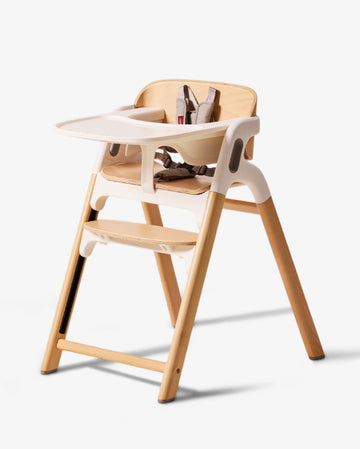
Yes, alternatives to a full-size high chair can work in a small apartment—but only when the child, the seat, and the furniture supporting it all meet the manufacturer’s instructions. A chair-mounted booster needs a stable, compatible adult chair. A hook-on chair needs a table edge the exact model approves. If you have neither, do not improvise with household furniture; consider only a compact freestanding feeding seat designed for your child, after measuring both its in-use and storage space.
The smallest option is not automatically the best option. Start with safe positioning and the furniture you actually have, then narrow the category.
Begin With Child Readiness and Secure Positioning
A feeding seat is not a shortcut around developmental readiness. General readiness signs include steady head and neck control and the ability to sit upright with support. For a booster in particular, the child should have good upright control and not need to lean backward for support.

Those signs are context, not a substitute for the specific product manual. Each seat can have its own age, size, weight, and developmental requirements. If you are unsure whether your child is ready for an upright feeding seat, use the manual and seek guidance from a pediatric professional.
Two rules apply regardless of the apartment layout:
- Keep the child upright in the seat as instructed.
- Use the supplied harness every time. A tray is a feeding surface, not a restraint.
Active supervision matters throughout the meal, including while preparing food, cleaning up, or reaching for something nearby.
Pick the Category That Matches Your Furniture
Think of the decision in terms of what safely supports the seat—not what looks smallest online.
If your apartment has… |
Category to investigate |
What supports it |
Key limitation |
A stable, suitable adult chair |
Chair-mounted booster |
The adult chair beneath it |
The booster does not provide its own stable base. |
A compatible dining-table edge |
Hook-on chair |
The table edge and attachment system |
A counter, island, desk, or other horizontal surface is not automatically approved. |
Neither a suitable chair nor an approved table edge |
Compact freestanding feeding seat |
Its own intended base |
Measure the open footprint and storage location before buying. |

Chair-mounted booster: useful when you have one good chair
A booster can eliminate the footprint of a freestanding high chair, but it depends entirely on the adult chair. The chair must be stable, and the booster must be attached using its intended anchoring system.
Do not treat a booster as a universal solution for any chair in the apartment. General feeding-seat guidance advises against unstable, soft, or bar-height chairs. Check the booster’s manual for the chair types, dimensions, and attachment points it permits.
Hook-on chair: useful only with an approved table edge
A hook-on chair can avoid a floor base by attaching to a compatible dining table. That can be appealing in a studio where every walkway matters.
However, “flat surface” does not mean “approved surface.” A kitchen counter, desk, island, or worktable should not be assumed compatible unless the manual for that exact hook-on chair explicitly says so.
Storage can be favorable for some models. One cited hook-on chair folds to 17 x 13.5 x 8 inches and weighs 9.5 lb assembled. Those are model-specific measurements, not a promise that every hook-on chair will fold that small—or that it will need little room while attached and in use.
No compatible furniture: do not force an attachment-based option
If you have neither a suitable adult chair nor an approved table edge, rule out both the booster and hook-on chair. That is not a failure of your layout; it simply means an attachment-based seat is not the right category for the space. Focus instead on freestanding options specifically designed for feeding, and compare their exact open dimensions, folded dimensions if provided, child eligibility, restraint system, and instructions.

Inspect Furniture Before You Buy
Measure and inspect the furniture first. This avoids buying a space-saving seat that cannot safely be used at home.
For a chair-mounted booster
The adult chair should be:
- Stable rather than soft, unstable, or bar-height.
- Compatible with the booster’s anchoring straps and instructions.
- Able to remain steady with the booster secured as directed.
- Used with the child harness fastened every time.
Do not assume a wide base, anchoring straps, or a child harness compensates for an unsuitable adult chair. Those features work within the product’s intended setup, not outside it.
For a hook-on chair
The table edge must meet the exact model’s instructions. As an example, one hook-on model permits tabletops 0.75 to 1.5 inches thick. That range is not universal, but it shows why measuring matters.
For that same model, prohibited setups include:
- Glass tabletops
- Loose tabletops
- Table leaves
- Card tables
- Single-pedestal tables
- Tablecloths or placemats
- Sloping / beveled tabletops (horizontal top surface with a sloping or angled underside)
Your model may have a different list. Measure tabletop thickness, check the clearance beneath the edge, and read every exclusion in its manual before purchase or installation.
Measure for the Apartment You Live In
A seat that technically fits can still be impractical if it blocks a cabinet, a walkway, or the only place you can prepare meals. Before buying, measure two separate zones:
- The feeding zone: Allow for the seat, the child, your ability to approach the seat, and normal access around the area.
- The storage zone: Measure the actual closet shelf, cabinet, wall gap, or under-bed space where the seat will go after meals.
Also consider the daily routine. A seat that must be carried, attached, removed, cleaned, and stored after every meal should be manageable for the person who will use it most often. Read the product documentation for the parts that require cleaning and how they are intended to be maintained.
Check Recalls Immediately Before Purchase or Use
Recall status can change. Check current official recall information immediately before buying a used or new feeding seat and again before using one already in your home.
For example, on June 5, 2025, about 1,000 Ravmix portable hook-on chairs, “Children’s table chair,” Model S006, were recalled because a removable crotch restraint could allow an infant to fall through an opening. Owners were instructed to stop using that specific model immediately and contact Ravmix for a refund. This was a product-specific recall, not a finding about all hook-on chairs. Read the CPSC recall notice for the Ravmix Model S006.
For U.S. products, search Recalls.gov as part of your final check.
Choose Your Next Step
- Confirm your child’s readiness for the specific type of upright feeding seat.
- Inventory your available furniture: stable adult chair, approved dining-table edge, or neither.
- Measure the feeding area and the exact place where the seat will be stored.
- Shortlist only seats in the category your furniture and layout can support.
- Read the exact manual, including child eligibility, attachment rules, harness instructions, dimensions, and exclusions; then check current recalls.
- Only after those checks align, visit a verified Momcozy product or collection page only if it matches the completed checklist.


